

BS 7858 is the British Standard code of practice for screening people who will work in a secure environment, and in the security industry it is the reference point many clients and auditors use for vetting. An auditor does not judge a screening file by how full the folder looks. They pick a file, pick a requirement and ask to see what supports it. Where the evidence was recorded at the time, that takes a minute. Where it was not, the file can fail on a point the screener probably did handle, just without writing it down.
1. Gaps in the five-year history
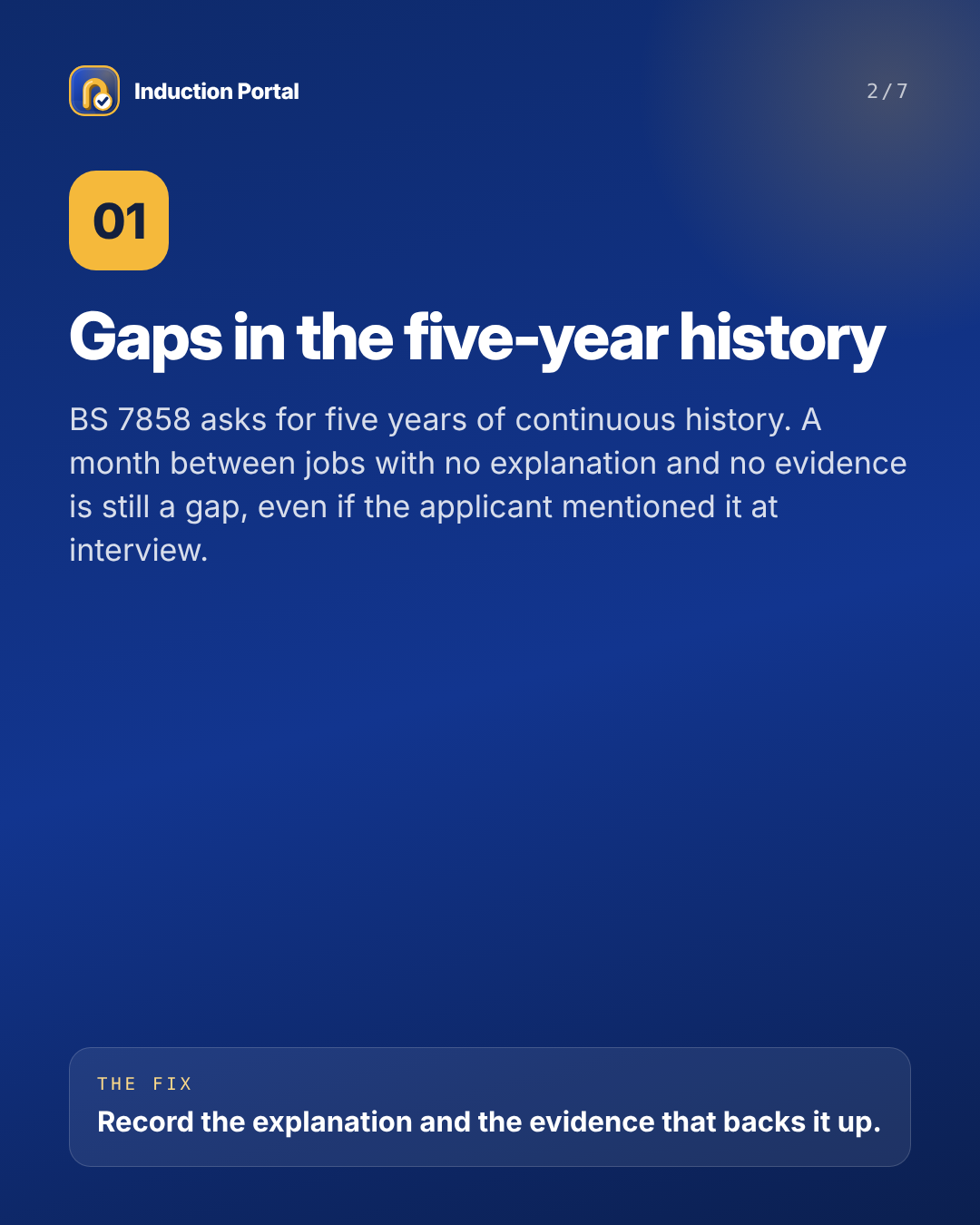
BS 7858 asks for five years of continuous history, so the screener can account for where the applicant has been and what they were doing. Employment, education, self-employment and time out of work all count. A month between jobs with no explanation and no evidence is still a gap, even if the applicant mentioned it at interview. A conversation is not evidence, and an auditor cannot check a memory.
The fix: record the explanation and the evidence that backs it up, such as a letter from a college, benefits correspondence or travel records, and note who accepted it and when.
2. References chased once, then dropped
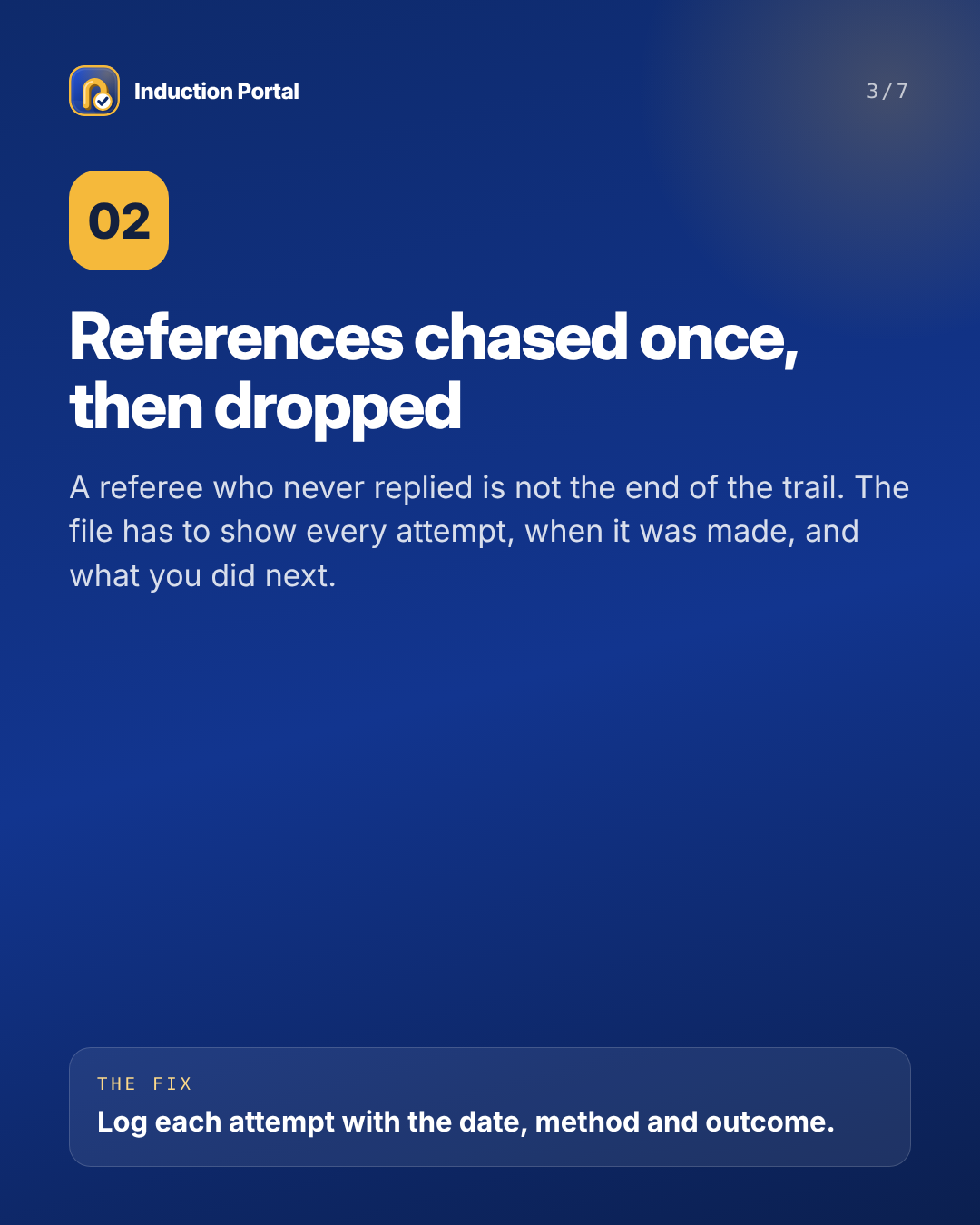
A referee who never replied is not the end of the trail. Businesses close, managers move on and shared inboxes go unanswered. The standard expects genuine efforts to verify each period, and an auditor will want to see those efforts, not hear about them. The file has to show every attempt, when it was made, and what you did next, whether that was a second request, a phone call or another route to confirm the same period.
The fix: log each attempt with the date, method and outcome.
3. SIA licence checked on day one only
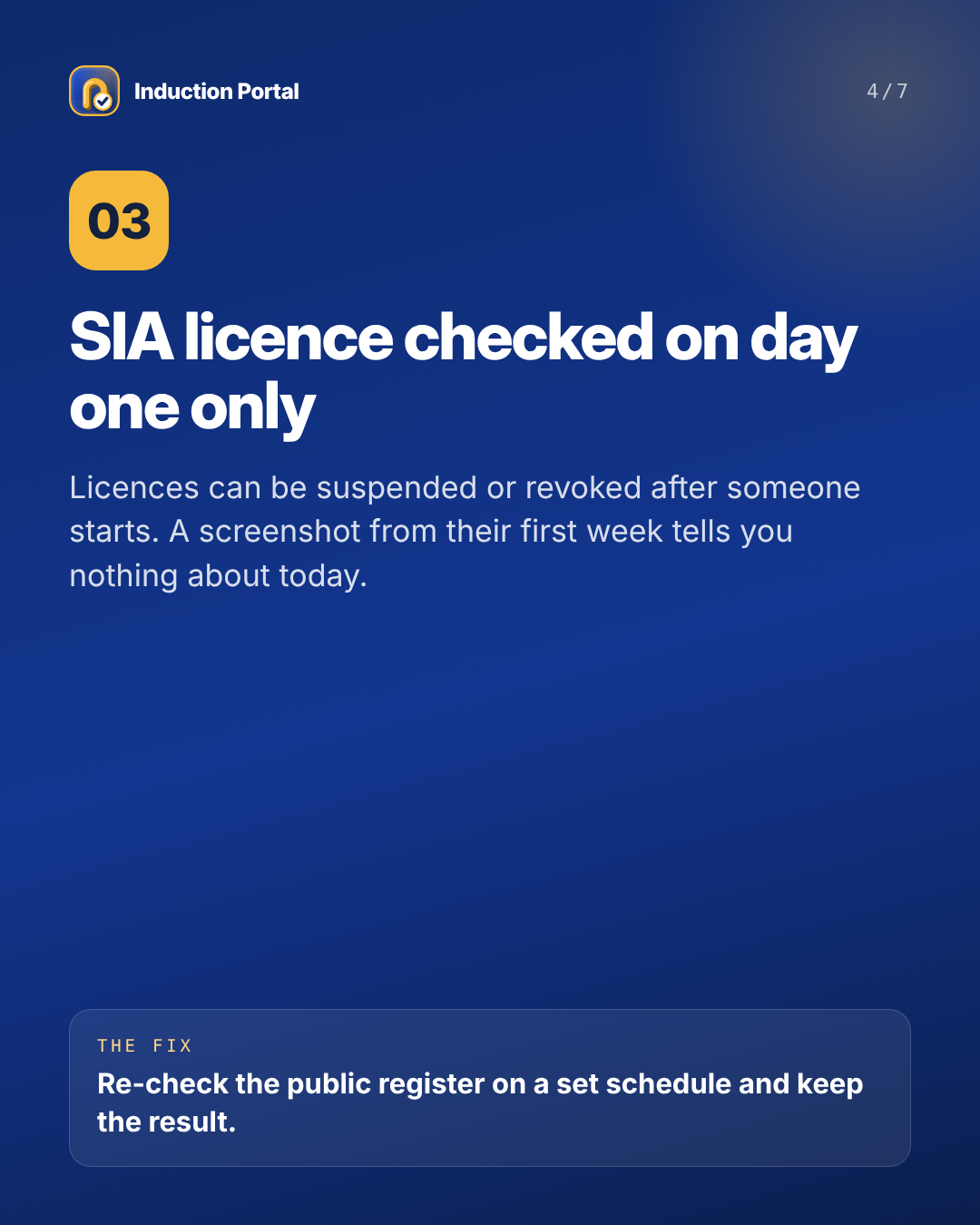
Licences can be suspended or revoked after someone starts. A screenshot from their first week tells you nothing about today. The Security Industry Authority publishes a register of licence holders that anyone can search, so a repeat check takes moments. How often you check is a matter for your own policy and your contracts; what matters is that the schedule is written down and followed.
The fix: re-check the public register on a set schedule and keep the result.
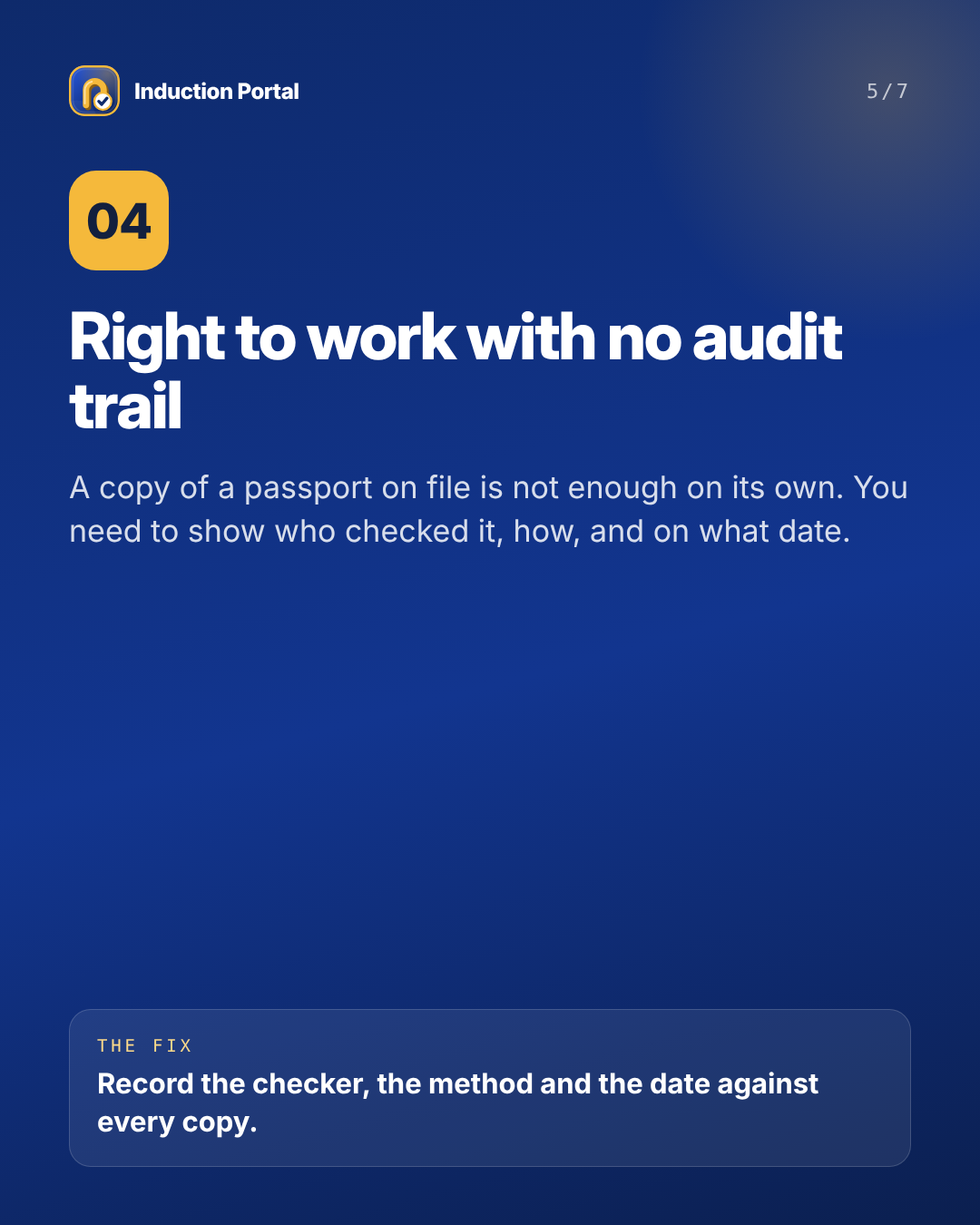
4. Right to work with no audit trail
A copy of a passport on file is not enough on its own. The Home Office guide for employers sets out how checks should be carried out and what records to keep. You need to show who checked it, how, and on what date. A manual document check, an online check using a share code and a digital identity check each leave different evidence, and the file should say which one was used.
The fix: record the checker, the method and the date against every copy.
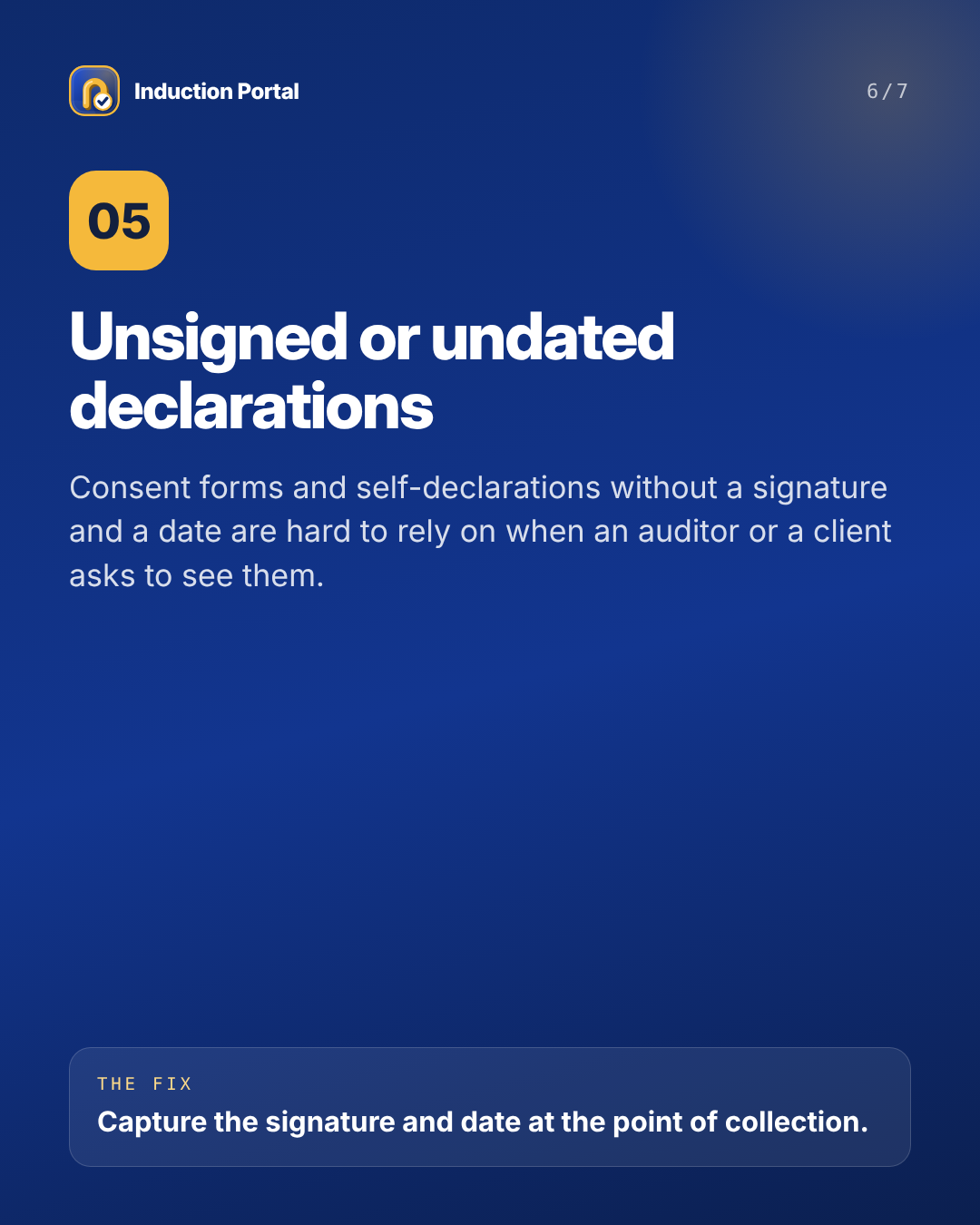
5. Unsigned or undated declarations
Consent forms and self-declarations without a signature and a date are hard to rely on when an auditor or a client asks to see them. Without a date you cannot show that consent came before the checks it covers. Without a signature you cannot show who gave it. Chasing signatures months later produces paperwork dated after the event, which raises more questions than it answers.
The fix: capture the signature and date at the point of collection.
The five gaps as a carousel
The same five gaps, one slide each, as they appeared on our social channels.
One record, every step accounted for
On Induction Portal, applicants work through an 8-step onboarding wizard. Their history, documents, declarations and consents land in one record aligned to BS 7858, with a certificate at the end. The compliance dashboard then shows who is complete and who is still outstanding, so a missing date or an unanswered reference shows up while it is still easy to close, not the week before an audit.
If your screeners want a grounding in what the standard asks for, start with the free BS 7858 course. You can see the businesses that use the platform on the member register. Membership is not an accreditation, approval or licence: the screening decisions, and the evidence behind them, remain the employer's responsibility.
Where the training fits
Each course below is a structured online course with an assessment and a QR-verifiable certificate recorded on your training matrix, so the people who build and check screening files can show what they have learned.
| Topic | Course |
|---|---|
| What BS 7858 asks for, from the five-year history to the screening decision | BS 7858:2019 Security Screening & Vetting, self paced, 3 to 6 hours. |
| Handling applicants' personal data lawfully, from consent to retention | GDPR: General Data Protection Regulation, 45 minutes. |
| The audit evidence an assessor looks for and where screening fits | ACS Approved Contractor Awareness, 40 minutes. |
| Recognising signs of exploitation during recruitment and right to work checks | Modern Slavery & Human Trafficking, 40 minutes. |
For the contents of a complete file, item by item, see our BS 7858 screening file checklist.
References
- GOV.UK, freedom of information release, Do security companies have to vet their staff in line with BS 7858? gov.uk, BS 7858 vetting FOI release
- Home Office, Right to work checks: an employer's guide. gov.uk/government/publications/right-to-work-checks-employers-guide
- GOV.UK, Security Industry Authority. gov.uk/government/organisations/security-industry-authority
- Security Industry Authority, Get Approved, Approved Contractor Scheme (PDF). assets.publishing.service.gov.uk, sia-acs-get-approved.pdf
- Induction Portal, BS 7858:2019 explained in plain English. inductionportal.co.uk/resources/articles/bs-7858-explained.html
Sources checked on 13 October 2026. BS 7858:2019 itself is a BSI standard available from BSI; the wording here is a plain-English summary of what it asks for in general terms, not a quotation from the standard. Check the current edition and your own contracts before relying on any point.