

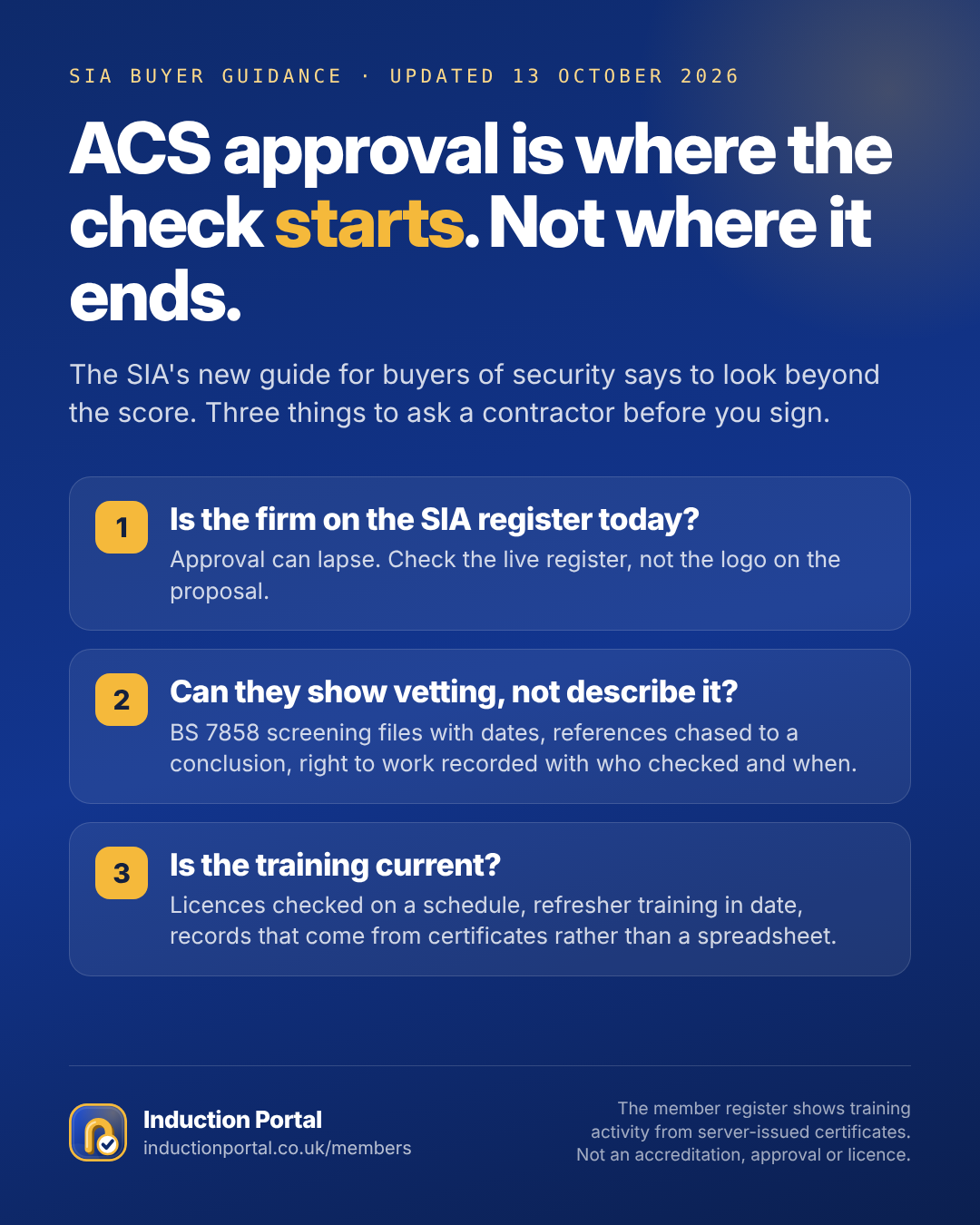
A buyer choosing a guarding or door supervision supplier usually meets the ACS logo on the front cover of the proposal. The SIA's new guidance treats that logo as a place to start, not a place to stop. Approval tells you a firm met a standard when it was assessed. It does not tell you whether next month's officers were screened properly, hold valid licences or have training in date. Those answers should be documents, not reassurances.
1. What the SIA guidance says
The guidance calls the Approved Contractor Scheme a recognised hallmark of quality for security providers, with approved firms assessed across 78 areas of their business. Approved firms are scored, and it is tempting to rank tenders on that number alone. The guidance asks buyers not to. It points to factors beyond the score, such as the firm's reputation in the marketplace and the quality of its tender response, and it tells buyers to confirm a contractor's status on the SIA's online register of approved contractors rather than relying on what the contractor says.
2. Check one: is the firm on the register today?
Approval is assessed and can lapse. A logo on a proposal shows what was true when it was printed; the live register shows what is true now. Search it by company name when you shortlist and again before you sign, and check that the legal entity on the register is the one named in the contract, since groups often trade through several companies.
Be clear about what the scheme is. The SIA licenses individuals and approves companies voluntarily, so ACS is not a legal requirement. That is why it carries weight as a quality signal, and why a buyer who makes it a tender condition should check it like any other condition.
3. Check two: can they show vetting rather than describe it?
Every bid says officers are screened to BS 7858. Ask to see it, either as a redacted sample of files for officers on a comparable contract or in a supervised review at the supplier's office. A complete BS 7858:2019 screening file should show:
- Identity verified, with the documents seen recorded on file.
- Right to work checked and recorded, with who checked and when.
- A five-year history, with any gaps explained.
- References chased to a conclusion, not left as a request that was sent.
- Declarations signed and dated by the employee.
A supplier who can produce these quickly runs screening as a process. A supplier who sends a policy document instead is describing what should happen.
4. Check three: is the training current?
Training is where proposals and reality most often drift apart. Ask for three things:
- Licence checks on a schedule. Licences expire and can be suspended or revoked. Ask how often officers' licences are checked against the SIA register, and for the date of the last check, not the one at onboarding.
- Refresher training in date. Since 1 April 2025, refresher training has been mandatory for Door Supervisor and Security Guard licence renewals. Ask which officers on your contract renew in the next twelve months.
- Records that come from certificates. A hand-updated spreadsheet records what someone typed. Records generated from issued certificates, each with an ID you can check, record what was completed.
5. Where Induction Portal fits
Induction Portal's public member register helps with check three. Each member is shown by its training activity, taken from server-issued certificates rather than a form the member fills in: a level from Established to Leading, the badges its roster has earned, and credentials such as ACS or ISO certificates marked Declared (listed by the member, not checked) or Verified by Induction Portal (our checker saw the document or register entry on a stated date). Every certificate behind it can be checked by its ID at /certificates.html#verify.
Membership is not an accreditation, approval or licence, and the register does not replace the SIA's register or the ACS. It is training evidence you can check.
Where the training fits
Each course below is a structured online course with an assessment and a QR-verifiable certificate recorded on your training matrix, so the evidence a buyer asks for exists as a record rather than a promise in a proposal.
| Topic | Course |
|---|---|
| Screening files that stand up to a buyer's sample check | BS 7858:2019 Security Screening & Vetting, self paced, 3 to 6 hours, covering the screening file and the statutory declaration. |
| How the ACS works, how firms are assessed and how daily work feeds the score | ACS Approved Contractor Awareness, for officers, supervisors and bid and compliance teams. |
| Core competencies and the licence renewal rules officers now work under | SIA Door Supervisor / Security Refresher, 60 minutes. It keeps competencies current between renewals and does not replace the formal SIA refresher qualification. |
| Occurrence and incident records a buyer can audit | Incident Reporting & Statement Writing: chronology, facts, language and signatures, 60 minutes. |
Pair these with the SIA's own registers: the register of approved contractors for a firm's status, and licence checks for each officer on the contract.
References
- Security Industry Authority, organisation page on GOV.UK. gov.uk/government/organisations/security-industry-authority
- Security Industry Authority, Choosing an SIA approved contractor, 13 October 2026, GovWire copy. govwire.co.uk, Choosing an SIA approved contractor
- Security Industry Authority, Guidance for SIA approved contractors, GOV.UK collection. gov.uk/government/collections/guidance-for-sia-approved-contractors
- Security Industry Authority, Get Approved, Approved Contractor Scheme. assets.publishing.service.gov.uk, sia-acs-get-approved.pdf
- Security Industry Authority, Check what training you need to get an SIA licence. gov.uk/guidance/check-what-training-you-need-to-get-an-sia-licence
Sources checked on 14 October 2026. SIA guidance is updated from time to time; check the GOV.UK text for the current wording before relying on it, and check the SIA's registers on the day for any firm's or officer's current status.